

All solutions here are suggested. Mr. Teng will hold no liability for any errors. Comments are entirely personal opinions
Numerical Answers (workings/explanations are after the numerical answers. Click to expand.)
Question 1: 
Question 2: 
Question 3: ![(-\infty, 11]; 7](http://theculture.sg/wp-content/ql-cache/quicklatex.com-b46f75bbeb74268b10505843c3182b69_l3.png "Rendered by QuickLaTeX.com")
Question 4: 
Question 5: 
Question 6: Sample; 
Question 7: 
Question 8: 
Question 9: 
Question 10: 
Question 11: 
Total marks: 6 marks
(a)
By comparing real and imaginary parts,

(b)




Total marks: 6 marks
Perimeter 
Area, 

The equation did not specify to use “calculus”, we may solve this graphically.
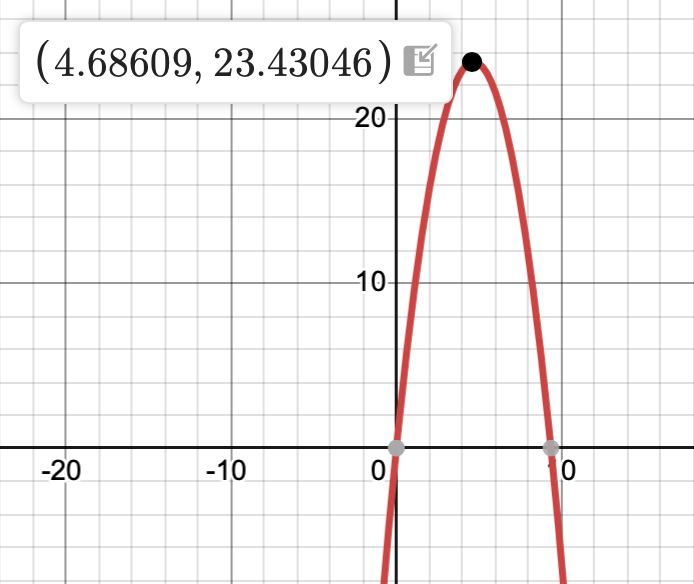
From the graph, the maximum point occurs when  and the maximum area
There is also discussion regarding the question phrasing, attached below.

And it seems that  should be the shorter side, which suggests that
  , now if that is the case, we will have that
  . Should
  , then the maximum area is
  . I do not know which is the better one. So we will only find out in 2025.
Total marks: 8 marks
(a)
![\Rightarrow R_f = (- \infty , 11]](http://theculture.sg/wp-content/ql-cache/quicklatex.com-931a0b57df4b54c0668c609c05c7494f_l3.png "Rendered by QuickLaTeX.com")
(b)
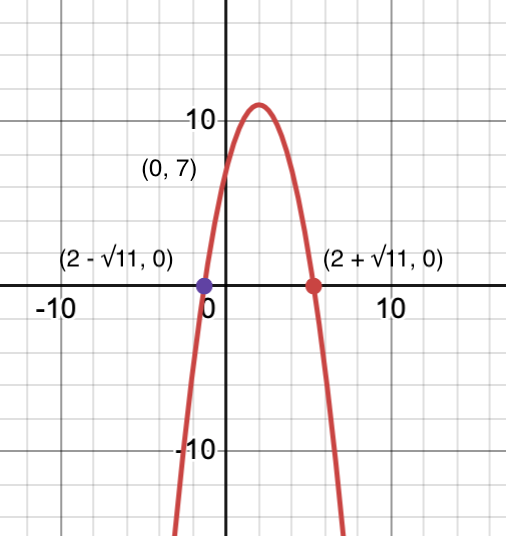
(c)
Method 1:
Draw the graph of  , do label the endpoints and explain the horizontal line test, i.e., Any horizontal line
  cuts the graph of
  at most once, thus, is a one-one function and
  exists.
Method 2: 
For  , we have the
  and
and  , thus is a strictly decreasing function and thus it is one-one. Thus, exists.
(d)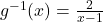

Total marks: 9 marks
(a)
![t_n = 2n^3 - 8n^2 - 4n - [2(n-1)^3 - 8(n-1)^2 - 4(n-1)]](http://theculture.sg/wp-content/ql-cache/quicklatex.com-330c0261a4fe47e9c98683247a7ba950_l3.png "Rendered by QuickLaTeX.com")
![t_n = 2n^3 - 8n^2 - 4n - [2(n^3 - 3n^2 + 3n-1) - 8(n^2 - 2n +1) - 4(n-1)]](http://theculture.sg/wp-content/ql-cache/quicklatex.com-a31f54ef54027779977657b592895dfb_l3.png "Rendered by QuickLaTeX.com")

(b)

Using GC,  or
or 
(c)
Using GC,
When 
When 
Thus, the smallest number greater than 100 in both series U and series V is  .
.
(d)(i)

Since  may be an odd or even number, observe that if is odd, then
  is even. Similarly if is even, then is odd. Clearly, the product of an odd and even number is even. This implies that
  is an even number.
Since  is a multiple of two, it must be even.
  is an odd number.
The sum of two even number is an even number, then  is an even number.
The sum of an even and an odd number is an odd number, then  must be an odd number. Thus all terms in series
  are odd numbers.
(d)(ii) .
.
Since  is a multiple of two, all terms in series
  are even numbers.
Since all terms in series are odd numbers, then series and series do not have any terms in common.
Total marks: 11 marks
(a)(i) Reflection of  about (in) the
  line
line
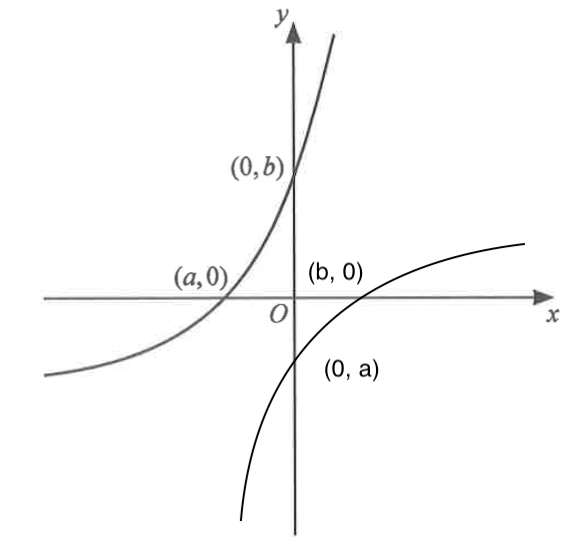
(a)(ii) Using the above graph, translate 1 units in positive  direction and scale by factor 2 parallel to the
  axis. Note question does not require the -intercept, which we should not be able to give.
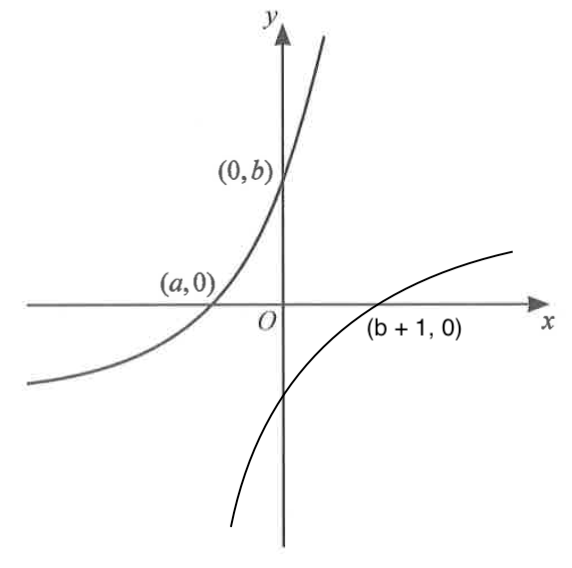
(b)(i)
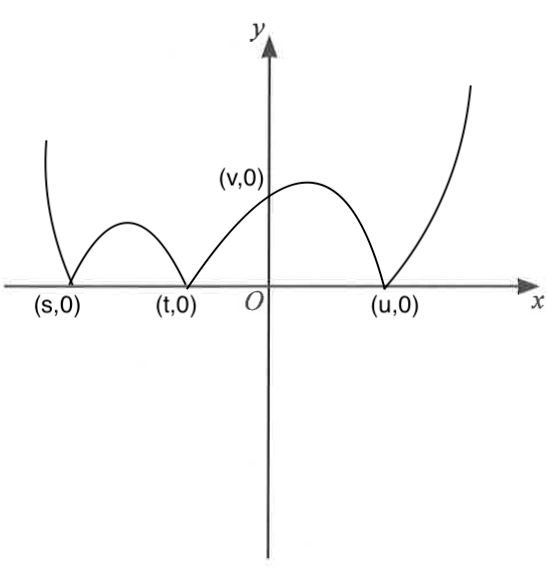
(b)(ii)
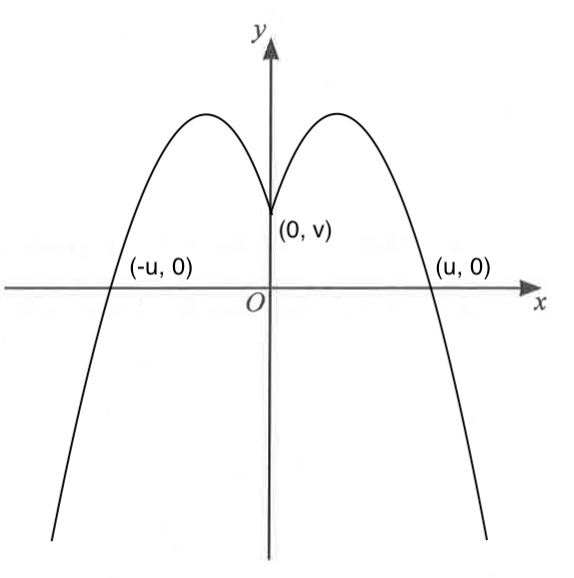
(c)(i)(ii)
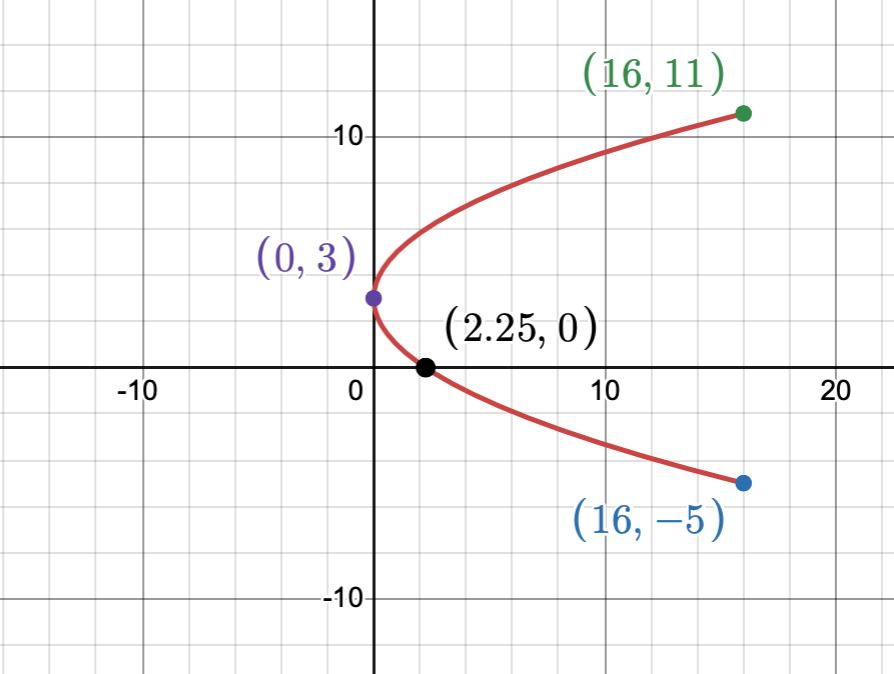
(c)(iii) The lines of symmetry is 
Total marks: 6 marks
(a) The 65 member comprise a sample since they form a subset of the population of 90 members.
(b) A random sample ensures that each member has an equal chance of being selected, independently of each other. This will avoid bias.
(c)
We start by finding the total number of ways:
AAAYYS: 
AAAYSS: 
AAAAYS: 
Required probability 
Total marks: 8 marks
(a)(i)
Required probability 
(a)(ii)
Required probability 
(a)(iii)


Total marks: 8 marks
(a) Lee should carry out a one-tailed test since he is testing for a definite decrease (reduction)
(b) Let  be the population mean number of birds visiting the feeder every morning.

(c)
Unbiased estimate of population mean 
Unbiased estimate of population variance 
Under  approximately by central limit theorem since sample size,
  is sufficiently large.
Using GC, p-value 
For  to be rejected, p-value
Thus, the minimum possible integer value of  is
is  .
.
(d) Lee can conclude with sufficient evidence at  level of significance that the mean number of birds visiting the feed in 20 minutes each morning has reduced.
(e) Since the distribution for the number of birds visiting the feeder every morning is unknown, a sample size of 10 mornings will be not sufficiently large to approximate the sample mean distribution to a normal distribution by central limit theorem.
Total marks: 11 marks
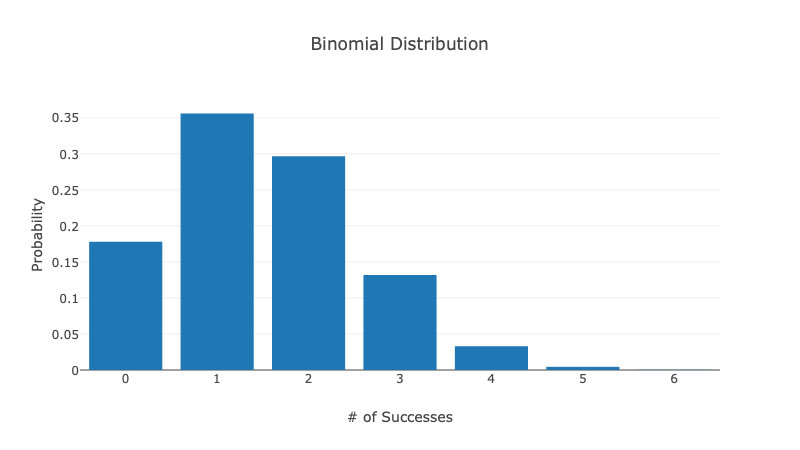
(a) Credits: https://people.hsc.edu/faculty-staff/blins/StatsTools/binomialPlotter.html
(b) Required probability 
(c)(i) The event that a randomly chosen burger has insufficient cheese in them is independent of another randomly chosen burger having insufficient cheese in them. The probability of a randomly chosen burger having insufficient cheese in them is constant at  for each trial.
(c)(ii)
Required probability


(c)(iii) Required answer  (3 s.f.)
(c)(iv) Let be the number of burgers found to have insufficient cheese in them, out of 3360 burgers.
Required probability


Total marks: 11 marks
(a) Let  be the masses of plates before drilling, in grams.
Required probability

(b) 

Let  be the number of plates with masses between 190g and 192g, out of 8 plates.
Required probability 


(c) Let 

Required probability 

(d) Let  and
and  be the masses of screws and bolts respectively, in grams.

For 20 drilled plates, we need 80 screws and 40 bolts.
Let 

Let  be the mass exceeded by just
  of the value packs.

Total marks:
(a)(i) The scatter diagram suggests that as  increases,
  increases decreasingly.
(a)(ii) Observe that both given models suggest the same trend and we will need to calculate the product moment correlation coefficient (PMCC) to select the appropriate model.
Using GC, PMCC for 
Using GC, PMCC for 
Since the PMCC for  is close to 1, it suggests stronger positive linear correlation between and
  . Thus, the more appropriate model. Using GC, we find that
  and PMCC
(a)(iii)  cents.
Since  is within the data range of
  , this is interpolation and the estimate is reliable.
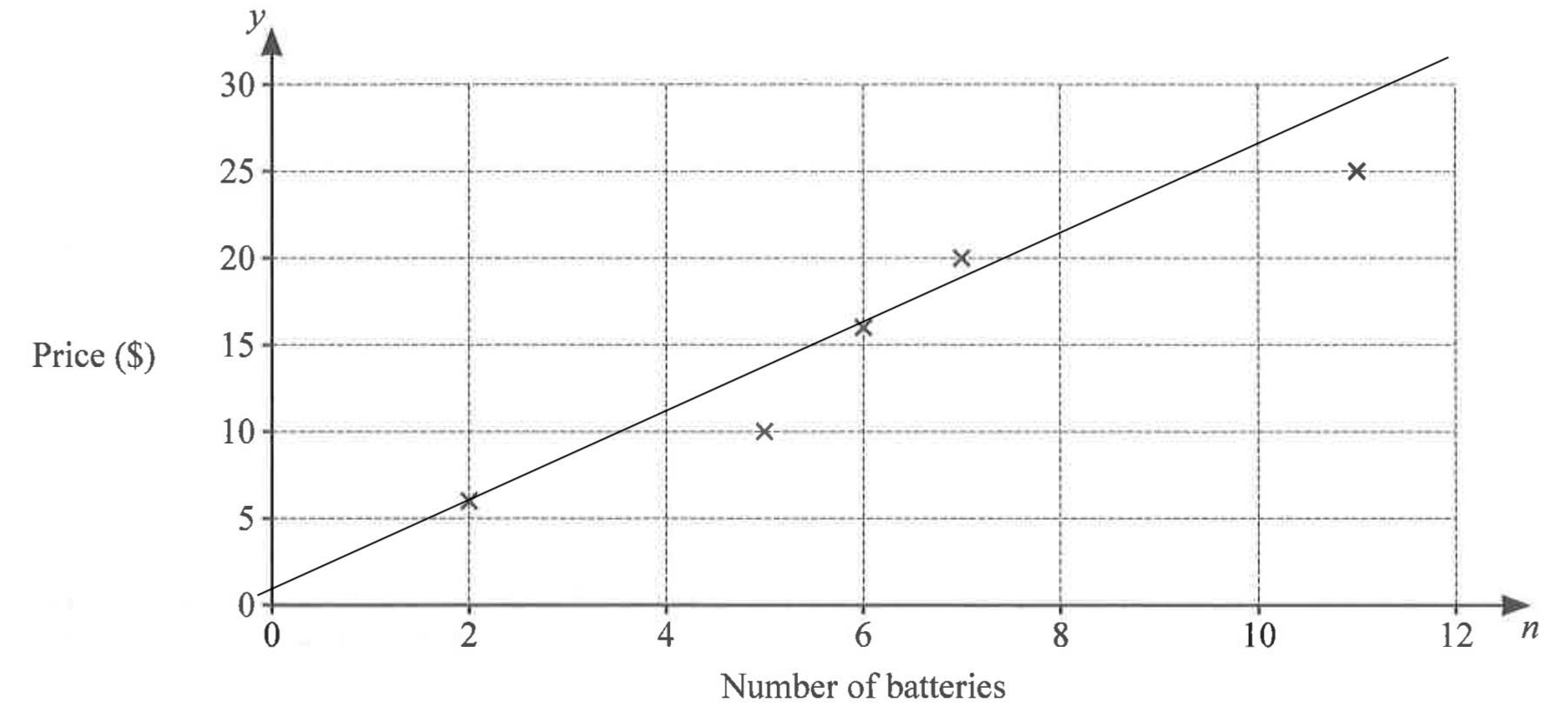
(b)(i)
(b)(ii)(A)
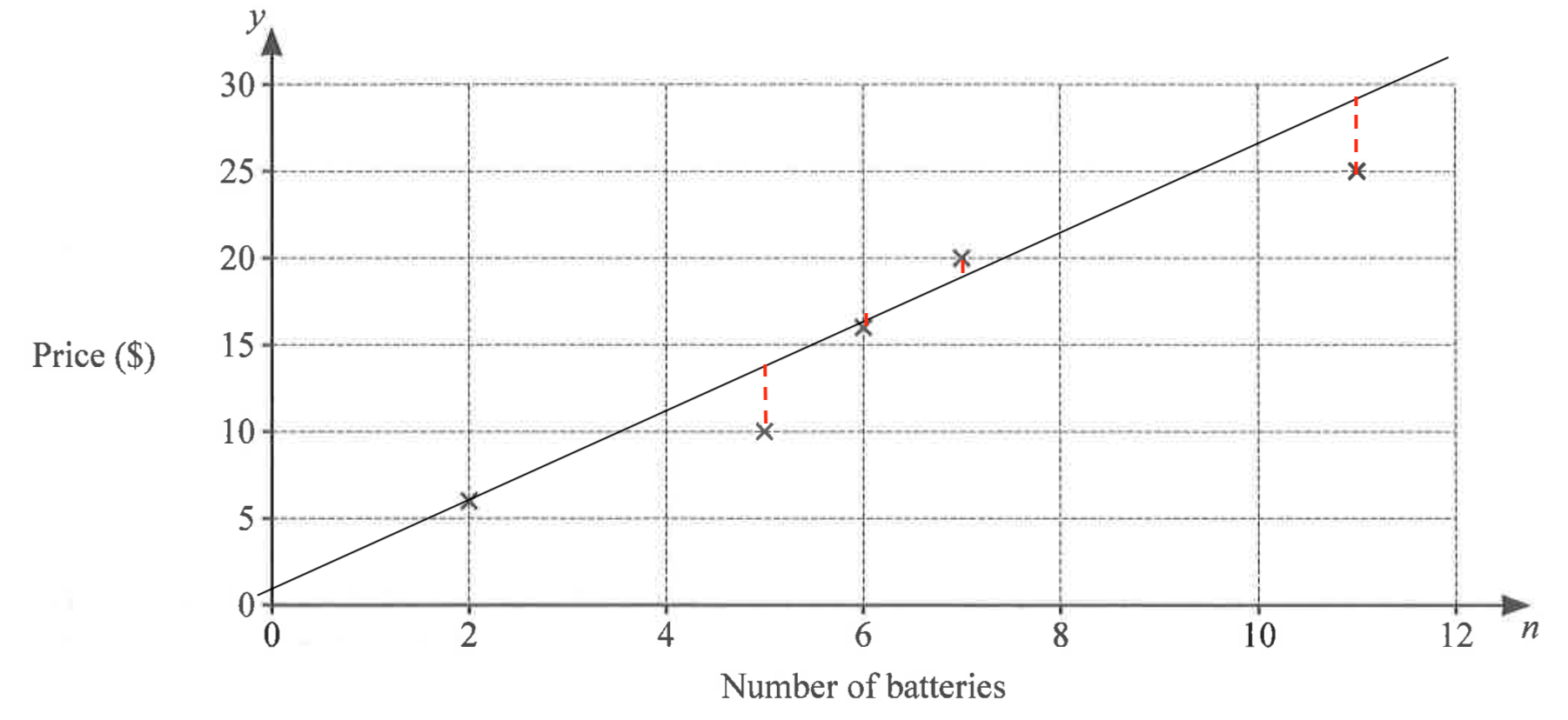
(b)(ii)(B) The residuals may be either positive or negative, and adding them out may result in them cancelling each other out. Squaring the residuals instead ensure the values will be positive and adding these values up will give a more meaningful result.
(b)(ii)(C) Using GC, required answers 
(b)(iii) The sum of squares of the residuals will have to be of a smaller value.
(b)(iv)
Sum of squares of residuals

Let 
We have that 


