

Lets look at brownian motion now. And yes, its the same as what our high school teachers taught about the particles moving in random motion. Here, we attempt to give it a proper structure and definition to work with.
A Brownian Motion is a random process  with parameters
  if
if
For  ,
,  are mutually independent. This is often called the independent increments property.
For 
 is a continuous function of t.
We say that is a  Brownian motion with drift
  and volatility
  .
.
For the special case of  and
and  , we have a standard Brownian motion. We can denote it with
  and assume that
If  and
and  then
then  where is a standard brownian motion. Thus,
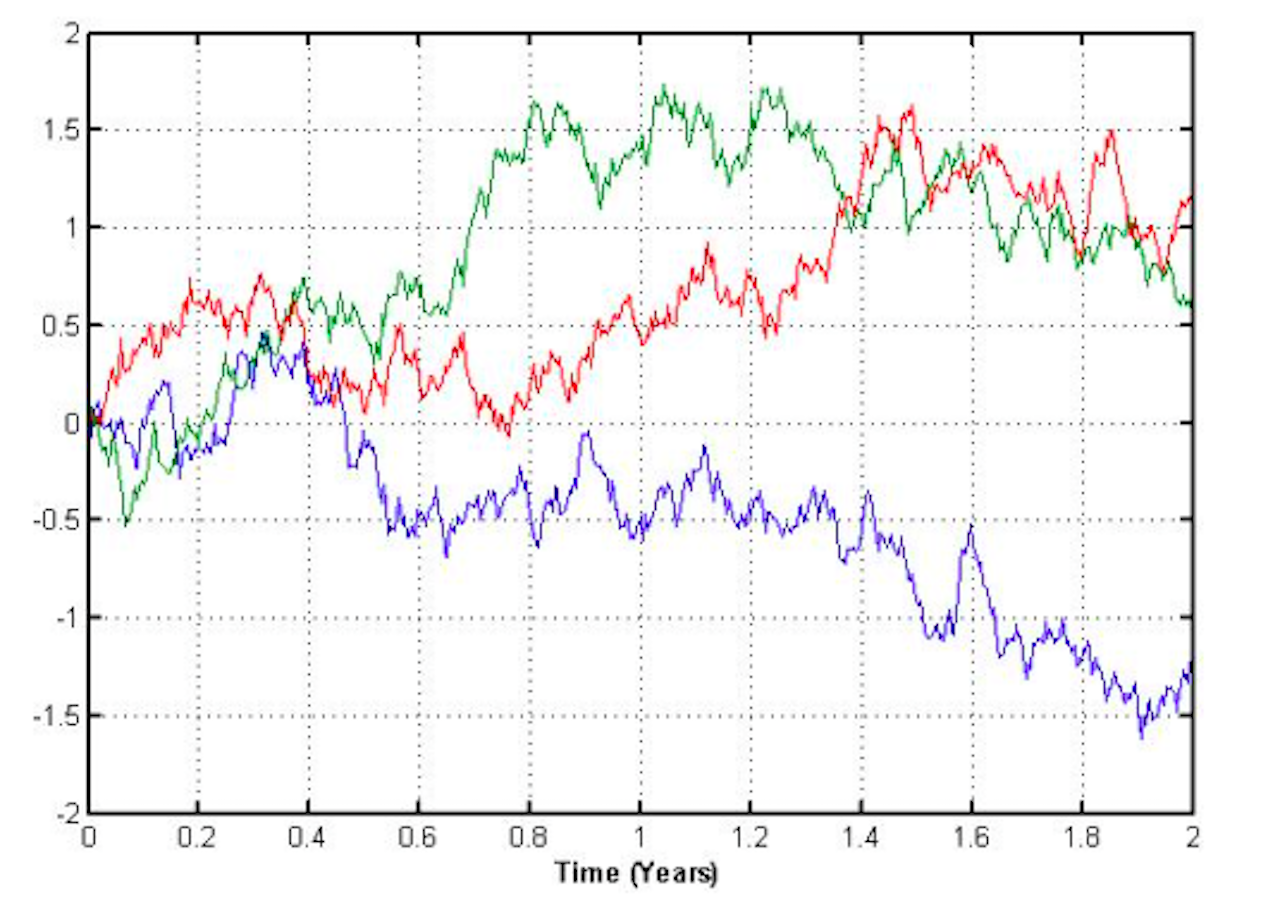
Random Paths of Brownian Motion. Source: Columbia University
The next concept is important in finance, that is, Information Filtrations.
For any random process, we will use  to denote the information available at time t.
– the set  is then the information filtration.
– ![\mathbb{E}[.|\mathcal{F}_t]](http://theculture.sg/wp-content/ql-cache/quicklatex.com-6e7feedd797735f42ee8b5b32f05bf91_l3.png "Rendered by QuickLaTeX.com") denotes an expectation conditional on time t information available.
denotes an expectation conditional on time t information available.
Note: The independent increment property of Brownian Motion implies that any function of  is independent of and that
  .
.
So let us do a bit of math to obtain ![\mathbb{E}_0[W_{t+s}W_s]](http://theculture.sg/wp-content/ql-cache/quicklatex.com-632da2b310281700f326ce2ccdbe9640_l3.png "Rendered by QuickLaTeX.com") for instance.
for instance.
Using condition expectation identity, we have
![\mathbb{E}_0 [W_{t+s}W_s]](http://theculture.sg/wp-content/ql-cache/quicklatex.com-e34b101842d6d9c747a317f8159ad97e_l3.png "Rendered by QuickLaTeX.com")
![= \mathbb{E}_0 [(W_{t+s} - W_s + W_s)Ws]](http://theculture.sg/wp-content/ql-cache/quicklatex.com-473b68925246c851835720e35b1d41f4_l3.png "Rendered by QuickLaTeX.com")
![= \mathbb{E}_0 [(W_{t+s}-W_s)W_s] + \mathbb{E}_0 [{W_s}^2]](http://theculture.sg/wp-content/ql-cache/quicklatex.com-d7ce8ac5638227dece2b9de1a837373e_l3.png "Rendered by QuickLaTeX.com")
![= \mathbb{E}_0 [\mathbb{E}_s[(W_{t+s} - W_s)W_s]] + s](http://theculture.sg/wp-content/ql-cache/quicklatex.com-7a97c53a217d8c8fa3530a34f5502cce_l3.png "Rendered by QuickLaTeX.com")
![= \mathbb{E}_0 [W_s \mathbb{E}_s[(W_{t+s} - W_s)]] + s](http://theculture.sg/wp-content/ql-cache/quicklatex.com-736ed18d019c44be031d855258711717_l3.png "Rendered by QuickLaTeX.com")
![= \mathbb{E}_0 [W_s 0] + s](http://theculture.sg/wp-content/ql-cache/quicklatex.com-f08af2de05de122812f9fab8bffef9d9_l3.png "Rendered by QuickLaTeX.com")


[…] Introduction to Brownian Motion – The Culture on Conditional Expectations and Variances […]
[…] the continuous-time model, will be the filtration generated by the stochastic processes (usually a brownian motion, ), based on the model’s […]
[…] Introduction to Brownian Motion […]